A backend framework decides how fast your team ships, who you can hire and how the application behaves under load. This guide covers the seven backend frameworks developers use the most: what each one is good at, where it struggles and how to choose between them.
The order follows the Stack Overflow Developer Survey 2025, the most recent edition, which was answered by more than 49,000 developers.
What is a backend framework?
A backend framework is a set of ready-made building blocks for the server side of an application: routing, database access, authentication, validation and background jobs. Instead of writing these parts from scratch, the team follows the structure of the framework and spends its time on the features that are specific to the product.
The idea is close to a content management system. WordPress gives you content management out of the box, as we explain in what a CMS is and how it makes website management easier; a backend framework gives you the plumbing of a custom application.
How popular is each framework?
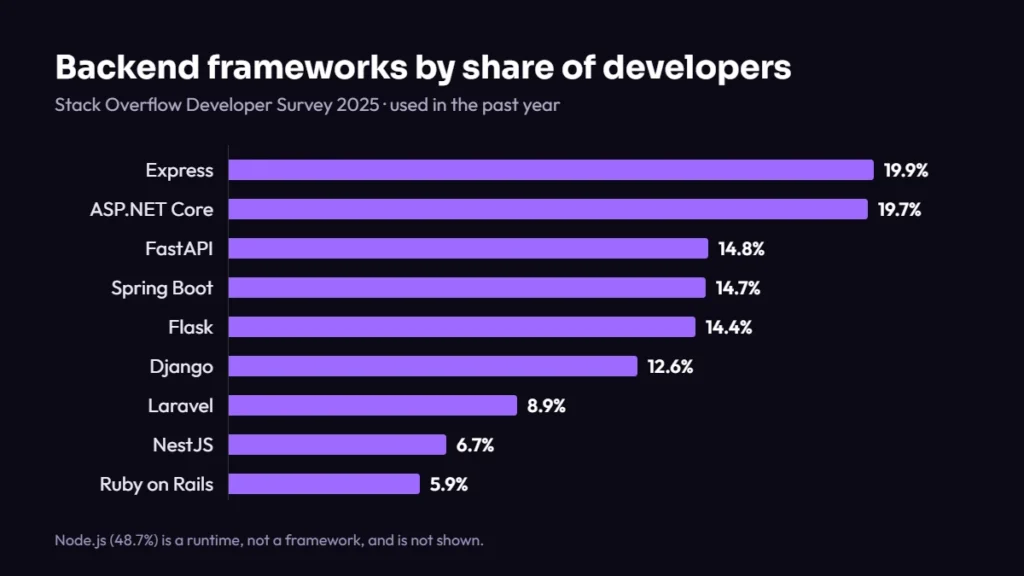
In the 2025 survey, these shares of developers said they had worked with each backend technology in the past year:
- Node.js: 48.7% (a JavaScript runtime rather than a framework, and the base for Express and NestJS)
- Express: 19.9%
- ASP.NET Core: 19.7%
- FastAPI: 14.8%
- Spring Boot: 14.7%
- Flask: 14.4%
- Django: 12.6%
- Laravel: 8.9%
- NestJS: 6.7%
- Ruby on Rails: 5.9%
Popularity is not the same as quality. It tells you how easy it will be to find developers, libraries and answers when something breaks.
1. Express (Node.js)
Express is a minimal web framework for Node.js, first released in 2010. It gives you routing and middleware and leaves every other decision to you.
Advantages
- One language everywhere: JavaScript or TypeScript on the front end and on the back end.
- Ecosystem: the npm registry has a package for almost every task.
- Quick start: a small API fits in a few files.
- Many connections at once: Node.js handles network and disk operations without blocking, which suits APIs and real-time features.
Disadvantages
- Little structure: every team arranges an Express project in its own way.
- You assemble the stack: database layer, validation and authentication are separate libraries that you choose and maintain.
- Heavy computation: CPU-intensive work blocks the event loop and has to move to worker threads or a separate service.
If you want more structure on Node.js, NestJS adds modules, dependency injection and TypeScript by default, and runs on top of Express or Fastify.
2. ASP.NET Core
ASP.NET Core is Microsoft’s framework for C#. Unlike the original ASP.NET, which ran only on Windows, it is open source and runs on Windows, Linux and macOS.
Advantages
- Performance and strong typing: many errors are caught at compile time.
- Complete toolkit: routing, dependency injection, authentication and the Entity Framework Core data layer come from one vendor.
- Tooling: first-class support in Visual Studio and Visual Studio Code.
Disadvantages
- More ceremony: for a small project it asks for more setup than a lightweight framework.
- Learning curve: developers new to C# and .NET need time to learn the platform.
- Ecosystem focus: it suits companies that already use Microsoft tools and Azure better than those that do not.
3. FastAPI
FastAPI is a Python framework for building APIs, first released in 2018 and built on Starlette and Pydantic. It uses Python type hints to validate requests and to generate interactive API documentation automatically.
Advantages
- Speed of development: validation and documentation come from the type hints you write anyway.
- Asynchronous by design: it handles many simultaneous requests well.
- Python ecosystem: a natural choice for serving data and machine learning models. For the AI side, see our overview of AI APIs for developers.
Disadvantages
- API only: there is no built-in admin panel, template layer or database layer.
- You assemble the stack: database access, authentication and background jobs are your choice.
- Younger ecosystem: fewer ready-made packages than Django has.
4. Spring Boot
Spring Boot is the standard way to build Java and Kotlin back ends. It was first released in 2014 and configures the large Spring ecosystem automatically, so an application starts with sensible defaults and an embedded web server.
Advantages
- Maturity: long used for large business systems, with libraries for security, data access and messaging.
- Strong typing and tooling: good support for refactoring and testing in large codebases.
- Performance: the Java Virtual Machine handles sustained load well.
Disadvantages
- Heavy for small projects: it uses more memory and starts more slowly than lightweight frameworks.
- Learning curve: annotations and layers of abstraction take time to understand.
5. Django
Django is the “batteries included” Python framework, released in 2005. The database layer, migrations, authentication, an admin panel and protection against common attacks such as SQL injection, cross-site scripting and CSRF all come in the box.
Advantages
- Admin interface: generated from your data models, so staff can manage content from day one.
- Secure defaults: the common mistakes are hard to make.
- Documentation: thorough and stable.
- Good fit: content-heavy websites and data-driven applications.
Disadvantages
- Opinionated: working against its conventions is hard.
- More than a small API needs: FastAPI or Flask is lighter for a single service.
- Asynchronous support: it exists, but much of the ecosystem is still synchronous.
6. Laravel
Laravel is the most widely used PHP framework. It was created by Taylor Otwell and first released in 2011.
Advantages
- Complete toolkit: the Eloquent database layer, queues, task scheduling, mail and authentication are included.
- Readable code and documentation: a new developer becomes productive quickly.
- Hosting: PHP runs on almost any hosting plan, which keeps costs low.
Disadvantages
- Hidden behaviour: conventions and facades do a lot behind the scenes, which makes debugging harder for newcomers.
- Performance under load: busy applications need caching and queues. The principles are the same as in object caching with Redis and Memcached.
- Yearly major releases: upgrades are regular work.
7. Ruby on Rails
Ruby on Rails, released in 2004, made “convention over configuration” popular: if you follow its naming and folder rules, most of the wiring is done for you. GitHub and Shopify are built on it.
Advantages
- Speed of development: a small team can build a complete product quickly.
- Consistency: Rails projects look alike, so a new developer finds their way fast.
- Mature libraries: there are well-tested gems for common needs.
Disadvantages
- Smaller talent pool: 5.9% in the survey, against 19.9% for Express and 12.6% for Django.
- Raw performance: lower than compiled languages, so scaling takes caching and careful engineering.
What about Flask, NestJS and Go?
Flask (14.4%) is a Python microframework: a good choice for a small service when Django is too much. NestJS (6.7%) is the structured option on Node.js. Go has no single dominant framework; many teams use its standard library with a small router such as Gin, Echo or Chi, and choose it for services that must handle many connections with little memory.
Where WordPress fits
Not every project needs a custom back end. When the core of the project is content, a catalogue or an online store, WordPress with WooCommerce already covers users, content, media and an admin interface. We build most client websites that way and write custom PHP only where the project needs it.
If you want more interactivity without a JavaScript framework, read HTMX and WordPress.
How to choose a backend framework
- Start from the team. The language your developers know best usually beats the most popular option.
- Match the framework to the product. Content and admin-heavy applications suit Django, Laravel or Rails. An API for a single-page or mobile app suits Express, FastAPI or ASP.NET Core. Large systems with many integrations suit Spring Boot or ASP.NET Core.
- Check hiring in your market. A framework is only as good as the developers you can find for it.
- Think about hosting. PHP runs almost anywhere; Java and .NET applications need more memory and a server you manage.
- Prototype the riskiest part first. A week spent on the hardest feature tells you more than any comparison table.
Not sure whether you need a custom back end at all? Tell us about your project and we will say which approach fits, or use the Website Price Estimator for a rough figure.